
Why can some 18mm phenolic plywood panels withstand multiple concrete pours, while others develop film damage, edge swelling or even delamination?
These differences are often caused not simply by panel thickness or film color, but by the quality of the surface film, internal bonding system, core construction and manufacturing processes.
Phenolic plywood generally refers to plywood bonded with phenolic resin adhesives or overlaid with phenolic resin-impregnated film. It is widely used in concrete formwork, vehicle flooring and other industrial applications.
From a manufacturer’s perspective, this guide explains the construction, properties, applications and quality assessment of phenolic plywood, helping importers, distributors and construction contractors specify the right products before placing bulk orders, reduce quality risks and control actual usage costs.
1. What Is Phenolic Plywood?
Phenolic plywood is a type of plywood that incorporates phenolic resin into its internal bonding system or surface overlay. Depending on where the resin is used, the resulting panels can have different construction characteristics and performance properties.
In international plywood trade, phenolic plywood commonly refers to two types of products:
| Product Type | Construction | Primary Function |
|---|---|---|
| Phenolic-Bonded Plywood | Multiple wood veneers bonded with phenolic resin adhesive | Improves moisture-resistant bonding and bonding durability |
| Phenolic Film Faced Plywood | Plywood overlaid with phenolic resin-impregnated film through hot pressing | Improves surface wear resistance, moisture resistance and ease of cleaning |
These two constructions are not mutually exclusive. A plywood panel may incorporate both phenolic adhesive and phenolic film, or it may have a phenolic film surface combined with a different internal bonding system.
What Is the Difference Between Phenolic Plywood and Film Faced Plywood?
In the construction formwork industry, phenolic plywood, phenolic coated plywood and film faced plywood are often used as related commercial terms. However, their naming principles and technical meanings are not identical.
| Comparison | Phenolic Plywood | Film Faced Plywood |
|---|---|---|
| Naming Basis | Use of phenolic resin | Surface overlay construction |
| Surface Film | Not necessarily present | Features a surface film or overlay |
| Internal Phenolic Adhesive | May be used | Depends on product configuration |
| Common Applications | Construction, industrial and other specialized applications | Concrete formwork, industrial flooring and related applications |
| Purchasing Priorities | Location and performance of phenolic resin | Film, core, bonding and service conditions |
Not all phenolic plywood has a surface film, and not all film faced plywood uses phenolic film. PP plastic-faced plywood, for example, uses a different surface material.
Formwork plywood and shuttering plywood, on the other hand, are primarily named according to their intended construction applications rather than their adhesive or overlay materials.
Fortuna’s Film Faced Plywood range includes Dynea film, anti-slip overlays, PP plastic overlays, and MDO and HDO surface options to meet different construction and commercial application requirements.
Therefore, specifying only “phenolic plywood” in an international purchase contract is not sufficient to define product quality requirements. Buyers should separately confirm the surface material, internal bonding system and intended service conditions.
2. Phenolic Film vs. Phenolic Glue: What’s the Difference?
Although both phenolic film and phenolic glue involve phenolic resin, they perform entirely different functions within a plywood panel.
Phenolic film primarily protects the panel surface, while phenolic glue bonds the internal wood veneers together.
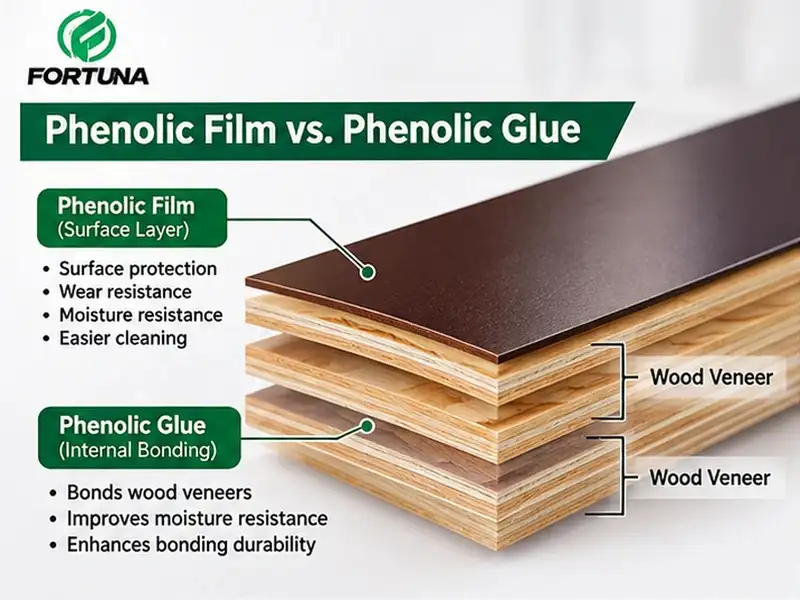
| Comparison | Phenolic Film | Phenolic Glue |
|---|---|---|
| Location | Panel surface | Between wood veneers |
| Primary Function | Surface protection and wear resistance | Internal structural bonding |
| Moisture Resistance | Reduces moisture penetration through the surface | Improves bonding durability under humid conditions |
| Impact on Construction | Concrete surface finish, cleaning and formwork release | Delamination risk and structural integrity |
| Purchasing Priorities | Film material, weight and surface performance | Adhesive type, bonding class and test results |
High-quality phenolic film cannot compensate for inadequate internal bonding. Similarly, using a durable phenolic resin adhesive does not necessarily guarantee good surface wear resistance or formwork release performance.
What Is the Difference Between Phenolic, WBP and MR?
Phenolic, WBP and MR are three terms that are frequently confused in international plywood procurement.
- Phenolic: Refers to phenolic resin as a material type. In plywood bonding systems, it generally refers to phenolic resin adhesives.
- WBP (Weather and Boil Proof): A commercial term commonly used to describe relatively high water-resistant and weather-resistant bonding performance. It does not identify a specific adhesive.
- MR (Moisture Resistant): Generally describes products with a certain level of moisture-resistant bonding performance. It does not indicate suitability for prolonged outdoor exposure.
Buyers should not assess actual water resistance solely on the basis of WBP or phenolic labels. Instead, they should confirm the bonding system, applicable standards, bonding class and corresponding test reports.
3. Properties, Advantages and Limitations of Phenolic Plywood
The main advantages of phenolic plywood include moisture resistance, surface wear resistance, bonding durability and ease of cleaning. However, actual performance depends on film quality, internal bonding, core construction and service conditions rather than phenolic resin alone.
| Performance Advantage | Purchasing Value | Limitations |
|---|---|---|
| Moisture Resistance | Reduces moisture penetration and panel swelling risks | Does not guarantee suitability for prolonged water immersion |
| Bonding Durability | Reduces delamination risks in humid environments | Depends on the actual bonding system and verified bonding class |
| Wear Resistance | Reduces surface damage during handling and repeated use | Affected by film quality and usage practices |
| Strength & Stability | Supports application-specific structural and dimensional requirements | Depends on core construction and mechanical properties |
| Easy Cleaning | Helps reduce formwork cleaning requirements | Improper cleaning may damage the film |
| Reusability | Helps reduce the cost per formwork use | Depends on construction conditions, maintenance and product configuration |
For concrete formwork, smooth phenolic film can help improve concrete surface finish and formwork release. However, the final results are also influenced by formwork joints, release agents, concrete mix design and construction practices.
Is Phenolic Plywood Completely Waterproof?
No. Phenolic film reduces moisture penetration through the panel surface, but it does not make the entire plywood panel completely waterproof.
Moisture can still enter the wood core through cut edges, drilled holes, damaged film and inadequately sealed areas. Even when a highly water-resistant bonding system is used, prolonged moisture absorption may cause wood veneers to swell, deform or experience changes in performance.
For applications involving frequent moisture exposure, buyers should therefore consider film quality, bonding class, edge sealing and ongoing maintenance requirements together.
4. What Determines the Quality of Phenolic Film Faced Plywood?
The quality of phenolic film faced plywood is primarily determined by the film material, core construction, internal bonding, hot pressing processes and edge sealing.
Buyers should not judge plywood quality solely by film color, panel thickness or the number of hot pressing cycles. Instead, the following factors should be evaluated together.
Film Weight and Surface Quality
Film weight, typically expressed in g/m², is an important purchasing specification for phenolic film faced plywood.
Industry technical publications, including the Handbook of Finnish Plywood, list film specifications such as 120 g/m², 170 g/m² and 220 g/m².
However, film weight is a purchasing specification, not an independent quality grade. Two films with the same weight may differ in base paper quality, resin content, impregnation uniformity and curing quality.
Buyers should pay particular attention to the following factors:
| Quality Factor | Impact on Product Performance |
|---|---|
| Film Weight | Amount of overlay material and potential surface protection |
| Base Paper Quality | Film uniformity and surface integrity |
| Resin Impregnation | Film durability and surface performance |
| Curing Quality | Film bonding and performance stability |
| Abrasion Resistance | Surface wear performance during repeated use |
| Surface Finish | Concrete surface quality and ease of cleaning |
A higher film weight may contribute to improved surface wear resistance, but actual performance must be evaluated together with film materials, manufacturing processes and test results.
Buyers should also confirm whether film weights specified by different suppliers are based on the same definitions and measurement methods.
Fortuna offers Dynea film options to meet different concrete formwork purchasing requirements. Specific film weights, surface properties and intended service conditions should be confirmed according to the order configuration.
Black Film Faced Plywood vs. Brown Film Faced Plywood
Black film faced plywood and brown film faced plywood are common product types in the construction formwork market.
However, film color alone is not a reliable indicator of plywood quality.
Both black and brown films can be manufactured using different film materials, resin systems, core constructions and internal adhesives.
Even when brown film is positioned as a premium option within a particular product range, this does not mean that all brown film faced plywood performs better than black film faced plywood.
Importers and distributors should select film colors according to their target market requirements and assess quality through actual product specifications, samples and performance testing rather than using color as an acceptance criterion.
Core Construction and Internal Bonding Quality
Core construction directly influences plywood’s mechanical properties, weight, dimensional stability and purchasing cost.
Fortuna offers birch, eucalyptus, poplar, combi and finger joint core options.
| Core Type | General Material Characteristics | Purchasing Considerations |
|---|---|---|
| Birch Core | Generally offers good strength and stiffness | Applications with higher mechanical performance requirements |
| Eucalyptus Core | Generally features relatively high wood density | Applications requiring durability and structural performance |
| Combi Core | Combines the performance and cost characteristics of different wood species | Balancing performance and bulk purchasing costs |
| Poplar Core | Relatively lightweight | Applications prioritizing handling efficiency and purchasing costs |
| Finger Joint Core | Improves wood material utilization | Cost-sensitive applications where suitability has been verified |
The core material name alone does not determine finished-panel quality. Core voids, veneer overlaps, veneer orientation and bonding quality all influence final performance.
For projects with specific load-bearing requirements, panel selection should be based on actual bending strength, modulus of elasticity and engineering design requirements rather than wood species or average density alone.
Hot Pressing and Edge Sealing Quality
Hot pressing affects adhesive curing, veneer bonding and the adhesion between the surface film and plywood substrate.
Fortuna’s film faced plywood range includes one-, two- and three-cycle hot pressing options. Different product configurations are manufactured through processes including veneer selection, adhesive application, lay-up, hot pressing, core repair, sanding and film application.
However, more hot pressing cycles do not automatically mean better quality. Appropriate temperature, pressure, pressing time and process control are essential to achieving consistent finished-panel quality.
Edge sealing also helps reduce moisture penetration into the plywood core. When formwork panels are cut or drilled on-site, exposed wood surfaces should be appropriately resealed according to the intended service conditions.
Purchasing Recommendation: Before placing bulk orders, confirm film specifications, core construction, bonding requirements, surface quality and edge sealing criteria. Verify the selected product configuration through samples and applicable test documentation.
Find the Right Film Faced Plywood for Your Market or Project
Compare available film types, core constructions, thicknesses and dimensions to identify a product configuration that meets your application requirements and purchasing budget.
5. What Is Phenolic Plywood Used For?
Phenolic plywood is primarily used in concrete formwork, infrastructure projects, vehicle flooring and industrial platforms where moisture resistance, surface wear resistance or mechanical performance is required.
Different applications have significantly different requirements for panel construction and surface performance.
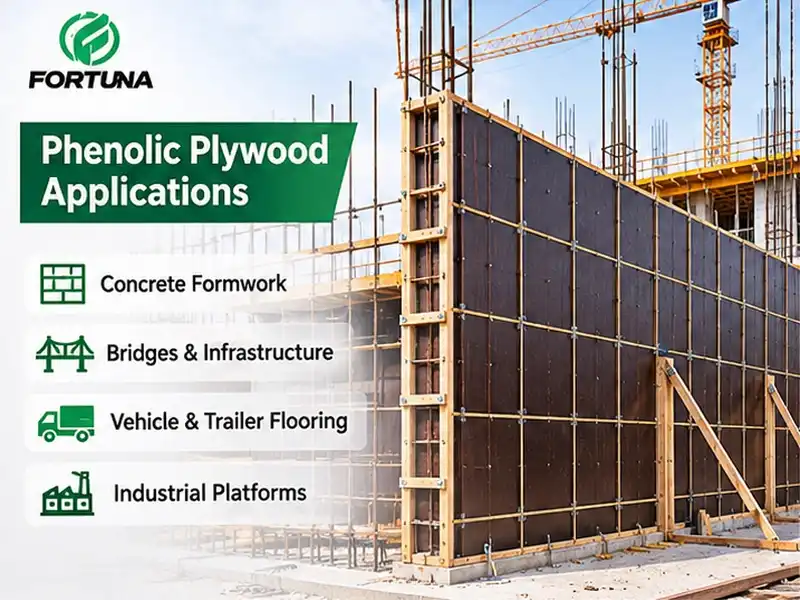
| Application | Primary Performance Requirements | Purchasing Priorities |
|---|---|---|
| Concrete Formwork | Smooth surface, moisture resistance and formwork release | Smooth film, bonding quality and thickness |
| Bridges & Infrastructure | Strength, stiffness and durability | Mechanical properties and formwork support design |
| Commercial Construction | Concrete surface finish, dimensional consistency and reusability | Film quality, core construction and dimensional tolerances |
| Vehicle & Trailer Flooring | Wear resistance, slip resistance and load-bearing performance | Anti-slip overlay, structural performance and test ratings |
| Industrial Platforms | Wear resistance, ease of cleaning and slip resistance | Surface texture, load requirements and working conditions |
| Industrial Workbenches | Surface wear resistance and ease of cleaning | Surface material and actual service conditions |
For concrete formwork plywood, smooth phenolic film is generally more suitable for applications requiring a smooth concrete surface finish.
For vehicle flooring and industrial platforms, textured anti-slip overlays can improve surface slip resistance. However, slip resistance ratings, abrasion resistance and load-bearing performance should still be verified according to the intended application.
Fortuna offers smooth formwork panels, anti-slip overlays and other specialized surface options, allowing buyers to select suitable configurations according to their target markets and functional requirements.
Standard construction formwork plywood should not be used as a direct substitute for load-bearing vehicle flooring or other specialized panels without appropriate performance verification.
6. How to Choose Phenolic Plywood for Bulk Orders
When purchasing phenolic plywood in bulk, buyers should first define the application, performance requirements and expected service conditions before selecting the appropriate film, core construction, bonding system and panel thickness.
For importers, distributors and construction contractors, appropriate product selection can reduce both quality risks and unnecessary purchasing costs.
Choose Product Configurations According to Purchasing Requirements
The following selection matrix can help buyers identify suitable initial product configurations and the technical parameters that require verification.
| Purchasing Requirement | Product Configuration to Consider | Key Verification Items |
|---|---|---|
| Cost-Effective Construction Formwork | Poplar core or suitable combi core | Bonding quality, thickness and construction conditions |
| High-Reuse Formwork | Durable film and stable core construction | Abrasion resistance, bonding performance and actual reuse performance |
| High-Quality Concrete Finish | Smooth and even surface film | Surface flatness, film defects and release performance |
| Heavy-Duty Engineering Formwork | Panel construction verified against design requirements | Bending strength, modulus of elasticity and engineering design data |
| Vehicle & Industrial Flooring | Anti-slip overlay and suitable core construction | Slip resistance, abrasion resistance and load-bearing performance |
| Distributor Private Label Programs | OEM configurations suited to target markets | Specification consistency, logo printing and packaging |
This matrix provides initial purchasing guidance rather than guarantees of specific engineering load capacities or product performance.
Confirm Panel Specifications, Thickness and Veneer Layers
Fortuna’s film faced plywood range offers multiple core materials, thicknesses, dimensions and surface configurations to meet the requirements of global importers, distributors and construction project buyers.
Fortuna Film Faced Plywood Specifications
| Specification | Available Options |
|---|---|
| Thickness | 9, 12, 15, 18, 21, 25, 27 and 30 mm |
| Standard Sizes | 1220 × 2440 mm, 1250 × 2500 mm and other sizes |
| Core Materials | Birch, Eucalyptus, Poplar, Combi, Finger Joint |
| Density | 520–750 kg/m³ |
| Moisture Content | 6%–14% |
| Film Options | Dynea Film and other options |
| Film Colors | Black, Brown, Green, Red, Blue, Gray |
| Hot Pressing | One, two or three pressing cycles |
| Customization | Thickness, dimensions, core materials, colors, logo and packaging |
| MOQ | 1 FCL (Full Container Load) |
Typical veneer layer configurations for different panel thicknesses are shown below.
| Panel Thickness | Available Veneer Layers |
|---|---|
| 9 mm | 5 layers |
| 12 mm | 7 or 9 layers |
| 15 mm | 9 or 11 layers |
| 18 mm | 11 or 13 layers |
| 21 mm | 13 or 15 layers |
| 25 mm | 15 or 17 layers |
| 27 mm | 17 or 19 layers |
| 30 mm | 19 or 21 layers |
These specifications represent the published range of Fortuna’s film faced plywood products. Not all parameter combinations are necessarily available for every phenolic film faced plywood configuration. Specific configurations and acceptance requirements should be confirmed for each order.
For concrete formwork, panel thickness should be selected according to concrete lateral pressure, construction loads, support spacing and allowable deflection.
An 18mm plywood panel is not necessarily suitable for every formwork system. Panels of the same thickness manufactured with different core constructions may also have different mechanical properties.
For further specifications and customization options, visit Fortuna’s Film Faced Plywood product page.
Verify Technical Standards and Test Reports
For purchasing projects with specific quality and engineering performance requirements, buyers should identify applicable technical standards according to the target market and intended application.
The following European standards provide references for verifying relevant plywood properties.
| Technical Standard | Scope | Purchasing Value |
|---|---|---|
| EN 314-1 | Plywood bonding quality — test methods | Establishes the testing basis for bonding performance |
| EN 314-2 | Plywood bonding quality — requirements | Helps determine the required bonding class according to service conditions |
| EN 636 | Plywood specifications and service conditions | Helps assess suitability for the intended service conditions |
| EN 310 | Determination of bending strength and modulus of elasticity of wood-based panels | Provides reference data for panel mechanical properties |
EN 314-2 includes different bonding classes associated with dry, humid and exterior conditions.
Using phenolic resin adhesive does not automatically mean that a plywood panel complies with EN 314-2 Class 3 requirements. Bonding class alone also does not demonstrate compliance with all structural application requirements.
For engineering procurement, buyers should further confirm actual panel construction, applicable standard editions, test methods, test results and engineering design data.
Buyers should also verify that test reports correspond to the core material, thickness and product configuration being purchased rather than simply checking whether a supplier possesses a test report.
Compare Cost per Use, Not Just Price per Sheet
For construction contractors, the actual purchasing value of phenolic film faced plywood depends not only on the price per sheet but also on the number of effective uses that meet the required quality standards.
The following formula provides a preliminary method for comparing panel purchasing costs per use:
Panel Purchasing Cost per Use = Purchase Price per Sheet ÷ Actual Number of Effective Uses
Consider the following hypothetical purchasing scenario:
| Comparison | Option A | Option B |
|---|---|---|
| Purchase Price per Sheet | $20 | $30 |
| Actual Number of Effective Uses | 5 | 12 |
| Panel Purchasing Cost per Use | $4.00 | $2.50 |
Panel Purchasing Cost per Use
Option A — $4.00
Option B — $2.50
Under the assumed conditions, Option B has a 37.5% lower panel purchasing cost per use than Option A.
This is a hypothetical calculation, not an actual Fortuna quotation or a guarantee of reuse cycles. Transportation, labor, cleaning, maintenance and material losses are excluded.
Although Option B has a higher initial purchase price, its panel purchasing cost per use is lower under the assumed conditions.
For formwork applications involving repeated use, buyers should therefore evaluate initial purchasing costs, effective reuse cycles, maintenance costs and concrete surface quality together rather than simply selecting the lowest-priced product.
Bulk Purchasing Specification Checklist
Before requesting quotations or confirming bulk orders with a manufacturer, buyers should define the following technical and commercial requirements.
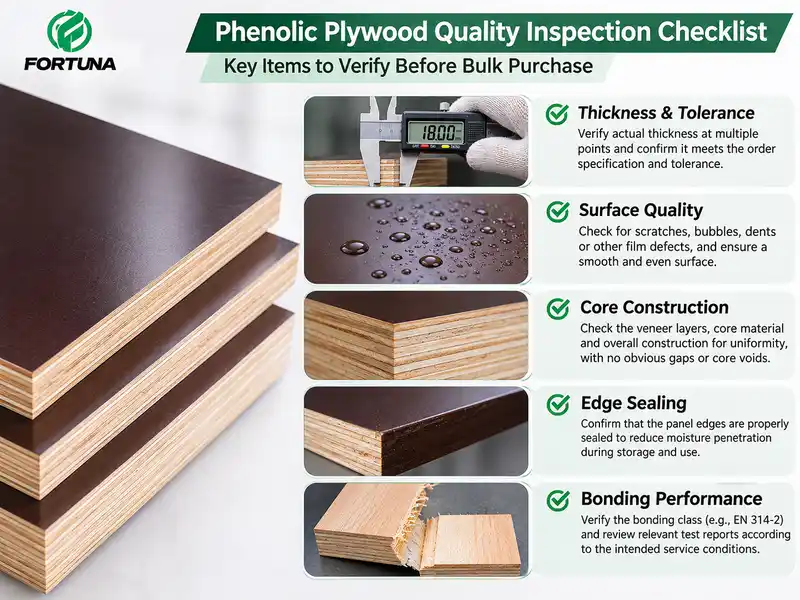
| Purchasing Item | Information to Confirm |
|---|---|
| Application | Intended application, construction environment and service conditions |
| Film Type & Weight | Film material, brand, color and weight |
| Core Material | Wood species, core construction and veneer layers |
| Glue & Bonding Class | Adhesive type, bonding class and testing requirements |
| Thickness & Dimensions | Thickness, length, width and permitted tolerances |
| Moisture Content | Moisture content range and acceptance requirements |
| Mechanical Properties | Bending strength, modulus of elasticity and applicable design data |
| Surface Quality | Surface flatness, film defects and appearance requirements |
| Edge Sealing | Sealing quality and protection requirements after secondary processing |
| Packaging & Quantity | Packaging configuration, labels, order quantity and transportation conditions |
For importers and distributors, approved samples, written technical specifications and quality acceptance criteria should be established before bulk production. These can then serve as references for subsequent orders and batch consistency management.
Clearly defined purchasing specifications improve quotation comparability and help reduce quality disputes after delivery.
7. Frequently Asked Questions About Phenolic Plywood
Can phenolic plywood be painted or laminated?
Yes, but compatibility between the panel surface and the coating or adhesive must be confirmed. Smooth phenolic film generally does not provide an ideal bonding surface for conventional paints or adhesives. Appropriate surface preparation, specialized primers or compatible adhesives may be required. Adhesion testing is recommended before bulk processing.
Can phenolic plywood be used outdoors permanently?
Not necessarily. Permanent outdoor use requires consideration of the panel’s service classification, bonding performance, film weather resistance, edge protection and actual exposure conditions. Standard phenolic film faced plywood intended for concrete formwork should not automatically be considered suitable for permanent outdoor applications.
How should phenolic plywood be stored before use?
Panels should be stored flat in a dry, ventilated and sheltered environment, protected from direct ground contact, rain and prolonged sunlight exposure. Stacks should be evenly supported, and heavy or sharp objects should be kept away from film surfaces to prevent damage.
Can Fortuna customize phenolic plywood for different markets?
Yes. Fortuna supports customization of core materials, thicknesses, dimensions, film colors, logo printing and packaging for film faced plywood. Importers and distributors can specify product configurations according to local market requirements, target pricing and intended applications. Final customization options are subject to order confirmation.
What specifications should I confirm before requesting phenolic plywood samples?
Buyers should first confirm the intended application, film type, core material, thickness, bonding requirements and performance characteristics to be verified. Fortuna can discuss suitable sample options based on purchasing requirements. For projects with specialized technical requirements, buyers should also confirm the product construction represented by the sample and the corresponding test documentation.
8. How Fortuna Helps Reduce Phenolic Plywood Sourcing Risks
Reliable phenolic plywood sourcing starts with appropriate product selection, clearly defined technical specifications and consistent manufacturing quality rather than simply comparing film colors, panel thicknesses or purchase prices.
Established in 1993, Fortuna operates a 208,000 m² manufacturing base, with an annual film faced plywood production capacity of 300,000 m³ and exports to more than 170 countries.
From veneer selection, core lay-up, adhesive application and hot pressing to sanding, film application, trimming, edge sealing and finished-product packaging, Fortuna uses different manufacturing processes and product configurations to meet the specification, quality and bulk supply requirements of global importers, distributors and construction project buyers.
With multiple core material options, Dynea film and OEM customization capabilities, Fortuna helps buyers select suitable Film Faced Plywood configurations according to their target markets, construction conditions, performance requirements and purchasing budgets.
Looking for Phenolic Film Faced Plywood That Meets Your Market or Project Requirements?
Share your intended application, core material, film requirements, thickness, dimensions and estimated order quantity to discuss suitable product configurations, sample support and factory pricing.