
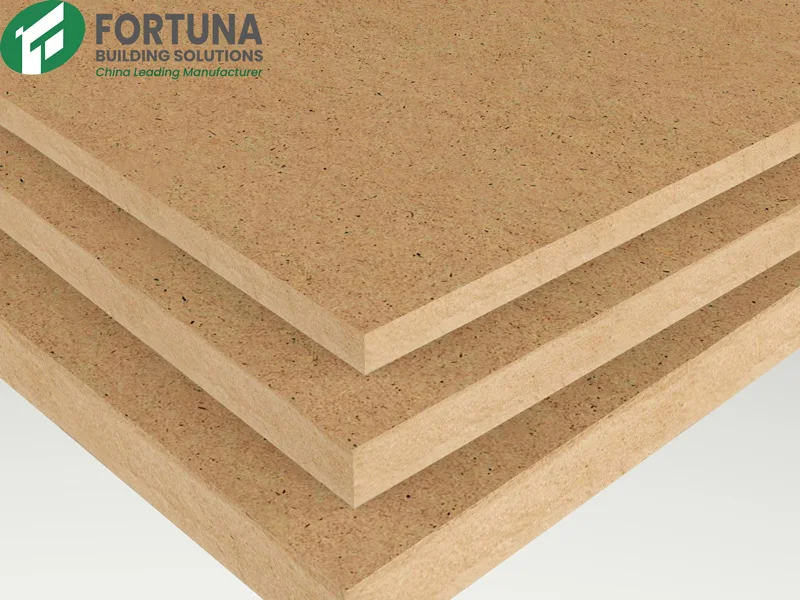
MDF (Medium Density Fiberboard) is an engineered wood panel made from wood fibers bonded with resin under heat and pressure. Its smooth surface and uniform structure make it widely used in furniture manufacturing, cabinet doors, shelving, and interior decorative panels.
Compared with plywood and particle board, MDF is particularly suitable for painted finishes and detailed machining. However, strength, moisture resistance, and cost should be considered when choosing the right panel for a specific application.
This guide explains what MDF is made of, its main types and uses, how it compares with other wood panels, and what buyers should check before purchasing.
What Is MDF Board Made Of?
MDF is made primarily from refined wood fibers and resin binders. The fibers are compressed under heat and pressure to form dense, uniform panels without the natural grain patterns or knots found in solid wood.
This fine-fiber structure provides a smooth surface suitable for painting, laminating, routing, and decorative machining. The final panel properties depend on fiber quality, resin formulation, density, and manufacturing conditions.
How Is MDF Manufactured?
MDF is manufactured by converting wood into fine fibers, mixing them with resin, and hot-pressing the material into panels.
The process typically involves five steps:
Wood preparation: Wood is cleaned and processed into chips.
Fiber refining: The chips are separated into fine wood fibers.
Drying and resin blending: Fibers are dried and mixed with resin binders.
Mat forming and hot pressing: The fibers are formed into a mat and compressed under controlled heat and pressure.
Cooling and sanding: Finished panels are cooled, trimmed, and sanded to achieve the required dimensions and surface finish.
Consistent fiber distribution, pressing conditions, and density control are important for reliable machining and panel performance.
What Are the Main Types of MDF Board?
The main MDF types include standard MDF, moisture-resistant MDF, fire-retardant MDF, and decorative products such as melamine-faced MDF.
| MDF Type | Main Features | Typical Applications |
|---|---|---|
| Standard MDF | Smooth surface and uniform structure | Furniture, cabinet doors, and interior panels |
| Moisture-Resistant MDF (MR MDF) | Improved resistance to humidity | Kitchen cabinetry and humid indoor environments |
| Fire-Retardant MDF (FR MDF) | Designed to meet specified fire-performance requirements | Interior projects requiring a particular fire classification |
| Melamine-Faced MDF | Decorative surface available in various colors and textures | Wardrobes, cabinets, and office furniture |
| High-Density Fiberboard (HDF) | Higher-density fiberboard, with catalog grades of 900–1100 kg/m³ | Flooring substrates, thin panels, and specialized applications |
Moisture resistance and fire performance must be verified against the relevant product grade and test requirements. Melamine-faced MDF is a surface-finished product rather than a separate moisture- or fire-performance classification.
High Density Fiberboard (HDF) is a related fiberboard product with a higher density than standard MDF. Fortuna’s catalog lists HDF density grades ranging from 900 to 1,100 kg/m³.
Is MDF the Same as Particle Board?
No. MDF is made from fine wood fibers, while particle board is manufactured from larger wood particles bonded with resin.
MDF generally provides a more uniform structure for detailed routing, decorative profiles, and painted finishes. Particle board is commonly used for laminated furniture, shelving, and cabinet components where cost efficiency is important.
For painted cabinet doors or detailed decorative components, MDF is often preferred. For economical flat-panel furniture with decorative surfaces, particle board can be a practical alternative.
The better choice depends on the application, panel grade, machining requirements, and budget.
MDF vs Plywood vs Particle Board: Which Is Better?
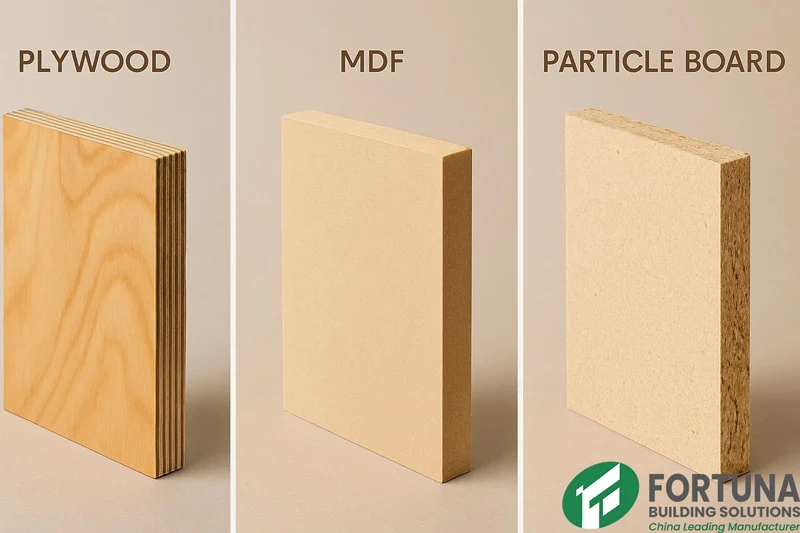
MDF is often preferred for smooth painted surfaces, plywood for applications requiring suitable mechanical strength and panel construction, and particle board for cost-sensitive furniture components.
| Factor | MDF | Plywood | Particle Board |
|---|---|---|---|
| Raw Material | Refined wood fibers | Layers of wood veneer | Wood particles |
| Surface | Smooth and uniform | Depends on veneer grade | Generally smooth |
| Painted Finishes | Well suited to painting | May require additional preparation | Exposed edges require more preparation |
| Detailed Machining | Suitable for routing and decorative profiles | Depends on veneer structure | Less suitable for detailed exposed-edge profiles |
| Screw Holding | Depends on density and fastening method | Often strong in suitable grades | Depends on grade and fastening method |
| Moisture Resistance | Grade-dependent | Grade-dependent | Grade-dependent |
| Typical Cost | Often mid-range | Often higher | Often lower |
| Common Uses | Cabinet doors, furniture panels | Cabinets, furniture, selected structural applications | Laminated furniture, shelving |
These are general material characteristics. Actual performance depends on panel thickness, grade, manufacturing quality, and test conditions.
Is MDF Stronger Than Plywood?
Plywood generally provides better bending strength and screw-holding performance than standard MDF in many comparable applications, although results depend on panel specifications.
Its cross-laminated veneer structure makes it suitable for various furniture and construction uses. MDF, meanwhile, provides a consistent surface for detailed machining and painted decorative components.
For load-bearing applications, buyers should compare bending strength, stiffness, fastening performance, and relevant test results rather than relying on material names alone.
Is MDF Cheaper Than Plywood?
Standard MDF is often less expensive than comparable furniture-grade plywood, but prices vary by thickness, density, grade, surface finish, and market conditions.
Specialized MDF products, including moisture-resistant or decorative grades, may cost more than some basic plywood products.
For furniture production, buyers should also consider machining waste, finishing costs, and material suitability—not just the price per sheet.
Choosing Between MDF, Plywood and Particle Board?
Explore Fortuna’s plywood products and other wood panel options to compare materials for your furniture or interior project.
What Is MDF Used For?
MDF is widely used in furniture manufacturing, cabinetry, interior decoration, and components requiring smooth surfaces or detailed machining.
| Application | Why MDF Is Used |
|---|---|
| Cabinet Doors | Smooth surfaces for painting and decorative routing |
| Wardrobes | Consistent panels suitable for decorative finishes |
| Furniture Components | Uniform surface and predictable machining |
| Interior Wall Panels | Suitable for decorative profiles and surface finishing |
| Office Furniture | Compatible with a range of decorative finishes |
| Interior Door Components | Suitable for selected flat and molded decorative components |
MDF is particularly useful for painted cabinet doors and CNC-machined furniture parts.
However, load-bearing shelves require careful consideration of thickness, span, support, and long-term deflection. Standard MDF is also unsuitable for prolonged exposure to water or outdoor weather.
Is MDF Waterproof?
No. Standard MDF is not waterproof and may swell or lose dimensional stability when exposed to excessive moisture, particularly along unsealed edges.
Moisture-resistant MDF is designed to perform better in humid indoor environments, but it is not intended for prolonged water exposure or outdoor use unless specifically rated for those conditions.
For kitchen cabinetry and similar applications, buyers should consider the appropriate MDF grade, surface protection, and proper edge sealing.
Learn more about moisture-resistant MDF and its suitable applications.
How to Choose MDF Board for Furniture Manufacturing
Furniture manufacturers should select MDF based on application, thickness, density, surface quality, emission requirements, and machining performance—not price alone.
For bulk purchasing, the following specifications are particularly important:
| Buying Factor | What to Check |
|---|---|
| Thickness | Required thickness and tolerance |
| Dimensions | Standard or customized panel sizes |
| Density | Suitability for machining and intended use |
| Surface Quality | Smoothness, sanding consistency, visible defects |
| Machining Performance | Cutting, drilling, routing, and edge quality |
| Emission Requirements | Applicable market standards and supporting reports |
| Moisture Resistance | Required grade and test performance |
| Packaging | Moisture protection and transport stability |
| Order Conditions | MOQ, lead time, loading quantity, and batch consistency |
What Sizes, Thicknesses, and Densities Are Available for MDF?
Fortuna’s MDF catalog lists panel thicknesses from 2 mm to 40 mm, with density options including 630, 650, 680, and 700+ kg/m³.
Available panel sizes listed in the catalog include 1220 × 2440 mm, 1830 × 2440 mm, 2100 × 2800 mm, and 1830 × 3660 mm. Customized specifications may also be available depending on production requirements.
Buyers should confirm the available combination of thickness, density, size, and emission requirements before placing a bulk order.
For painted cabinet doors, surface quality and edge machining are especially important. For wardrobes and laminated furniture, buyers should also consider surface finish compatibility, panel dimensions, and fastening requirements.
For large-volume orders, consistency between production batches can be as important as the properties of an individual sample.
How Does Fortuna Support MDF Manufacturing and Bulk Supply?
Established in 2008, Shandong Fortuna’s MDF factory covers 280,000 square meters and operates a fully automated production system incorporating German Dieffenbacher continuous press technology. The production process is designed to support consistent panel density, strength, and manufacturing quality.
With a daily production capacity of 2,000 m³ and an annual output of 600,000 m³, the factory supports large-volume MDF supply for international buyers. Quality control includes laboratory testing, production process monitoring, and finished-panel inspection. These procedures help maintain consistent MDF quality and identify potential issues before shipment.
Fortuna uses fresh poplar wood rather than recycled wood materials in its MDF production. This approach supports raw material consistency and helps maintain reliable panel quality.
For importers, distributors, and furniture manufacturers, Fortuna combines manufacturing capacity, automated production, and quality control to support bulk procurement requirements.
Buyers can explore Fortuna’s MDF board products and specifications before requesting a quotation.

What Information Should Buyers Provide When Ordering MDF?
To obtain a suitable MDF recommendation and an accurate quotation, buyers should provide:
Application: Cabinet doors, wardrobes, furniture panels, or interior decoration
Thickness and size: Required dimensions and tolerances
MDF grade: Standard, moisture-resistant, or another specified grade
Surface finish: Raw MDF, melamine-faced, or other required finish
Emission requirements: Applicable standards for the destination market
Order quantity: Estimated volume or container requirements
Destination: Country or discharge port
Clear specifications help reduce misunderstandings, improve sample matching, and support more accurate quotations.
Sourcing MDF Boards for Furniture Manufacturing?
Fortuna supports MDF procurement for furniture manufacturers, importers, and distributors. Share your required thickness, dimensions, grade, surface finish, quantity, and destination to discuss suitable products and bulk pricing.
Frequently Asked Questions About MDF
Can MDF Be Painted?
Yes. MDF is suitable for painting because of its smooth, uniform surface. Proper sanding, sealing, and priming are important, especially on cut edges, which can absorb more paint than the panel surface.
Can MDF Be Used for Kitchen Cabinets?
Yes. MDF is commonly used for kitchen cabinet doors and selected cabinet components. The appropriate grade, protective finish, edge sealing, and exposure conditions should be considered, particularly near sinks and other moisture-prone areas.
What Is the Difference Between MDF and HDF?
HDF (High Density Fiberboard) generally has a higher density than standard MDF and is used for applications requiring different density-related or mechanical properties.
MDF is widely used for furniture, cabinet doors, and decorative panels, while HDF is commonly used in certain flooring substrates, thin panels, and other specialized applications.
What Is the Standard Size of MDF Board?
A common MDF board size is 1220 × 2440 mm (4 × 8 ft). Fortuna’s catalog also lists larger panel sizes, including 1830 × 2440 mm, 2100 × 2800 mm, and 1830 × 3660 mm.
Available dimensions and thicknesses should be confirmed with the supplier based on the required MDF grade and order quantity.
Conclusion: Choosing the Right MDF Board
MDF is a versatile engineered wood panel valued for its smooth surface, uniform structure, and machining flexibility. It is particularly suitable for painted furniture, cabinet doors, and interior decorative components.
Compared with plywood and particle board, MDF offers distinct advantages for surface finishing and detailed machining, but the right material depends on strength requirements, moisture exposure, cost, and intended use.
For furniture manufacturers and bulk buyers, confirming panel specifications, application requirements, and production consistency is essential before placing an order.
Explore Fortuna’s MDF board range or contact our team to discuss your project requirements and request a bulk quotation.