
When sourcing particle board wholesale, most buyers naturally compare board thickness, surface finish, certifications, and price. However, one specification has a far greater impact on product quality, manufacturing efficiency, transportation costs, and long-term purchasing value than many buyers realize—particle board density.
Choosing the wrong density doesn’t just affect the board itself. It can lead to poor screw-holding performance, increased machining waste, higher freight costs, surface defects during lamination, and even customer complaints after installation. These hidden costs often exceed the initial savings gained from purchasing a lower-priced board.
Experienced furniture manufacturers, cabinet producers, importers, and distributors understand that density is not simply a number listed on a technical data sheet. It is a specification that influences every stage of the supply chain—from production and machining to logistics, installation, and the finished product’s service life.
Whether you’re purchasing from a particle board manufacturer, evaluating a new particle board supplier, or comparing multiple quotations, understanding how density affects performance will help you make better purchasing decisions while reducing long-term production costs.
This guide explains how professional buyers evaluate particle board density, how to choose the right density for different furniture applications, what mistakes to avoid during procurement, and how reliable manufacturers maintain consistent quality across every production batch.
Quick Answer
If you’re looking for the “best” particle board density, there isn’t a single answer.
The ideal density depends on your product application, machining process, structural requirements, transportation budget, and target market.
For most furniture manufacturing, boards between 650–700 kg/m³ provide the best balance of strength, machining performance, surface quality, and overall cost efficiency. Higher density may improve load-bearing capacity, but it also increases board weight, shipping costs, and processing difficulty.
Instead of requesting the highest density available, experienced buyers focus on selecting the specification that delivers the best overall value throughout the entire production cycle.
Expert Insight
The best particle board is not the one with the highest density. It is the one that delivers consistent quality, stable machining performance, and the lowest total manufacturing cost for your specific application.
At a Glance: Recommended Density for Common Applications
Choosing the right density becomes much easier when you start with the intended application rather than the technical specification itself.
| Application | Recommended Density | Why It Works |
|---|---|---|
| Residential Furniture | 620–680 kg/m³ | Good balance between cost, strength, and machining efficiency |
| Kitchen Cabinets | 650–700 kg/m³ | Better screw-holding strength and long-term durability |
| Office Furniture | 650–720 kg/m³ | Improved structural stability for frequent daily use |
| Wardrobes & Storage Cabinets | 650–700 kg/m³ | Consistent performance with decorative surface finishes |
| Heavy-duty Shelving | 700–750 kg/m³ | Higher load-bearing capacity for demanding applications |
| Decorative Interior Panels | 620–680 kg/m³ | Smooth surfaces suitable for melamine, PET, UV, or veneer lamination |
| Budget Furniture | 600–650 kg/m³ | Lower material and transportation costs while maintaining acceptable performance |
Procurement Tip
Density should always be selected according to the furniture design and end use. Specifying unnecessarily high density often increases manufacturing and freight costs without delivering proportional performance benefits.
Why Particle Board Density Matters for Wholesale Buyers
For wholesale buyers, density is much more than a technical parameter—it is a purchasing decision that directly affects product quality, manufacturing efficiency, logistics costs, and long-term profitability.
Many buyers compare quotations based primarily on price per sheet. Professional procurement teams take a different approach. They evaluate how density will influence machining performance, production efficiency, transportation costs, and the overall lifecycle value of the finished product.
A small difference in density may appear insignificant on a specification sheet, but during mass production it can create measurable differences in manufacturing performance and operating costs.
Better Machining Efficiency
Consistent particle board density allows CNC equipment, edge banding machines, and cutting tools to perform more predictably.
Boards with stable density generally produce cleaner cuts, smoother edges, and more accurate machining, helping manufacturers reduce material waste while improving production efficiency.
For factories processing hundreds or even thousands of panels each month, these improvements translate directly into lower operating costs.
Stronger Screw-Holding Performance
Furniture durability depends heavily on the board’s ability to securely hold screws and connectors.
Selecting the appropriate density improves fastening performance, reducing the risk of loose joints, cabinet deformation, or structural failure after installation.
This is especially important for kitchen cabinets, wardrobes, office furniture, and shelving systems that experience frequent loading and repeated daily use.
Better Decorative Surface Quality
Modern furniture increasingly uses melamine paper, PET films, UV coatings, veneers, and other decorative finishes.
A board with consistent density provides a smoother substrate, helping manufacturers achieve better lamination results while reducing surface imperfections during pressing.
This leads to higher-quality finished products and fewer defects during production.
Lower Transportation and Logistics Costs
Higher density also means greater board weight.
While heavier panels may provide additional strength in specific applications, they also increase container weight, freight costs, and material handling expenses.
For importers purchasing particle board wholesale, selecting the appropriate density often delivers a better overall return than simply choosing the highest specification available.
The objective is not to maximize density—it is to optimize total purchasing cost.
Improved Product Consistency
For distributors and furniture manufacturers, consistent quality matters far more than occasional peak performance.
Stable density across every production batch improves machining consistency, minimizes product variation, and helps manufacturers maintain reliable quality standards across large-volume orders.
This becomes particularly valuable for businesses supplying long-term retail programs, OEM furniture brands, or commercial construction projects where consistency is essential.
Buyer Takeaway
Professional buyers rarely ask, “Which particle board has the highest density?”
Instead, they ask:
“Which density provides the best balance between strength, machining efficiency, transportation cost, and long-term product performance?”
That shift in thinking is what separates strategic procurement from simple price comparison.
Which Particle Board Density Is Right for Different Applications?
One of the most common questions buyers ask is:
“Which particle board density should I specify?”
The answer depends less on the board itself and more on how the finished product will be used.
A wardrobe, an office desk, a kitchen cabinet, and a decorative wall panel all have different structural requirements. Selecting the same density for every product may simplify purchasing, but it rarely delivers the best balance between performance and cost.
Experienced buyers start with the application, then choose the density that best matches production requirements, expected service life, and transportation budget.
Recommended Density by Application
| End Use | Recommended Density | Why It Is Recommended |
|---|---|---|
| Flat-pack & budget furniture | 600–650 kg/m³ | Lightweight, economical, and suitable for cost-sensitive products. |
| Residential furniture | 620–680 kg/m³ | Good balance between machining performance, strength, and production cost. |
| Kitchen cabinets | 650–700 kg/m³ | Better screw-holding strength and improved durability in daily use. |
| Wardrobes & closets | 650–700 kg/m³ | Stable structure with excellent compatibility for decorative surfaces. |
| Office furniture | 650–720 kg/m³ | Higher structural stability for products subjected to frequent use. |
| Commercial shelving | 700–750 kg/m³ | Increased load-bearing capacity for demanding environments. |
| Decorative wall panels | 620–680 kg/m³ | Smooth substrate suitable for melamine, PET, veneer, or UV finishes. |
These ranges represent common industry practices rather than fixed rules. Factors such as board thickness, furniture design, fastening methods, export market standards, and expected product lifespan should always be considered together.
Procurement Tip
Rather than asking your particle board supplier for the highest-density board available, explain your end application first.
An experienced supplier can often recommend a specification that reduces production costs while maintaining the required product performance.

Does Higher Density Always Mean Better Quality?
Many buyers assume that a heavier board automatically means a better board.
In reality, that assumption often leads to unnecessary purchasing costs.
Higher density generally improves load-bearing capacity and screw-holding performance, but it also increases board weight, transportation costs, machining resistance, and production expenses.
For many furniture applications, those additional costs provide little practical benefit.
A well-manufactured board with a balanced density often outperforms an excessively heavy board that adds cost without improving the finished product.
Professional procurement is about selecting the most appropriate specification—not the highest specification.
Particle Board Density Comparison Chart
The table below summarizes how different density ranges typically perform across common purchasing considerations.
| Density Range | Typical Applications | Main Advantages | Considerations |
|---|---|---|---|
| 600–650 kg/m³ | Budget furniture, RTA furniture | Lower cost, lighter weight, reduced freight expenses | Lower screw-holding strength for heavy-duty furniture |
| 650–700 kg/m³ | Cabinets, wardrobes, office furniture | Excellent balance of strength, machining, and cost | Recommended for most furniture manufacturers |
| 700–750 kg/m³ | Heavy-duty shelving, commercial furniture | Higher load capacity and improved durability | Increased shipping costs due to heavier panels |
| 750 kg/m³+ | Industrial or specialty applications | Maximum strength and wear resistance | Higher material cost and rarely necessary for standard furniture |
Expert Insight
For most furniture manufacturers, 650–700 kg/m³ delivers the best overall balance between structural performance, machining efficiency, transportation cost, and long-term product value.
Procurement Scenario: Choosing the Right Density
Consider a furniture manufacturer producing modular kitchen cabinets for export.
Initially, the purchasing team specified 720 kg/m³ particle board for every component, believing that a higher density would guarantee better quality.
After reviewing the product design, their supplier suggested a different approach.
Instead of using the same specification throughout the project:
- Cabinet shelves and structural components continued using higher-density boards for improved load-bearing performance.
- Side panels, partitions, and non-structural components were changed to 650 kg/m³ boards.
- Decorative panels maintained the same appearance while becoming easier to machine and transport.
The result was a measurable improvement across the project:
- Lower material weight per container
- Reduced international freight costs
- Faster CNC machining
- Less tool wear during production
- Lower overall manufacturing cost
- Consistent furniture quality
The project demonstrated an important lesson:
Choosing the right density for each application often creates greater value than specifying the highest density for every board.
Procurement Decision Framework
Before requesting quotations from a particle board manufacturer, ask the following questions.
Step 1 — What type of furniture are you producing?
Standard residential furniture → 620–680 kg/m³
Cabinets, wardrobes, office furniture → 650–700 kg/m³
Heavy-duty shelving or commercial applications → 700–750 kg/m³
Step 2 — Is transportation cost a major concern?
If shipping costs represent a significant portion of your total purchasing cost, selecting a moderately dense board may provide better overall value than choosing the heaviest specification.
Step 3 — Will decorative finishes be applied?
Products laminated with melamine paper, PET film, veneer, or UV coatings benefit more from a board with consistent density than from maximum density.
Uniform density improves lamination quality and surface appearance.
Step 4 — Are you planning long-term wholesale purchasing?
If you’re purchasing particle board wholesale on a regular basis, consistency between production batches becomes far more important than marginal increases in density.
Reliable manufacturing consistency reduces production adjustments, improves quality control, and simplifies inventory planning.
Procurement Takeaway
Professional buyers don’t ask:
“What is the highest density available?”
They ask:
“Which density delivers the best long-term value for my product, production process, and market?”
That question almost always leads to a better purchasing decision.
Why Consistent Density Matters More Than Maximum Density
After comparing density ranges and selecting the right specification, many buyers assume the purchasing decision is complete.
In reality, another factor often has an even greater impact on product performance than the density value itself:
Manufacturing consistency.
Two suppliers may both offer 650 kg/m³ particle board, yet the boards can perform very differently during cutting, edge banding, lamination, furniture assembly, and long-term use.
The difference is not the specification printed on the data sheet.
It is the manufacturer’s ability to produce consistent quality from one production batch to the next.
For furniture manufacturers producing thousands of cabinets, wardrobes, office desks, or shelving units every month, consistency is often more valuable than pursuing the highest specification available.
What Causes Density to Vary Between Manufacturers?
Density is influenced by far more than the target value listed on a quotation.
Several manufacturing factors determine whether a board performs consistently throughout its service life.
These include:
- Raw wood species and particle grading
- Moisture content before pressing
- Resin formulation and distribution
- Multi-layer mat forming accuracy
- Hot pressing temperature and pressure
- Sanding precision and thickness calibration
- Quality inspection throughout production
If these processes are not carefully controlled, two boards with the same nominal density may produce completely different machining and furniture performance.
This is why experienced procurement teams evaluate the manufacturer’s production capability—not just the specification sheet.
Why Consistency Creates More Value Than Higher Density
For furniture manufacturers, consistent density delivers measurable operational benefits throughout production.
Instead of constantly adjusting CNC machines or replacing damaged cutting tools, production teams can maintain stable machining parameters from one order to the next.
Instead of sorting boards with inconsistent performance, assembly lines can operate more efficiently.
Instead of dealing with customer complaints caused by dimensional instability or weak screw-holding performance, manufacturers can deliver more consistent finished products.
Over time, these improvements often generate greater savings than purchasing a slightly cheaper board.
Industry Insight
Professional buyers rarely ask for the highest-density board.
They look for a supplier capable of delivering the same quality, the same density consistency, and the same machining performance across every shipment.
Consistency reduces production risk. Consistency builds long-term profitability.
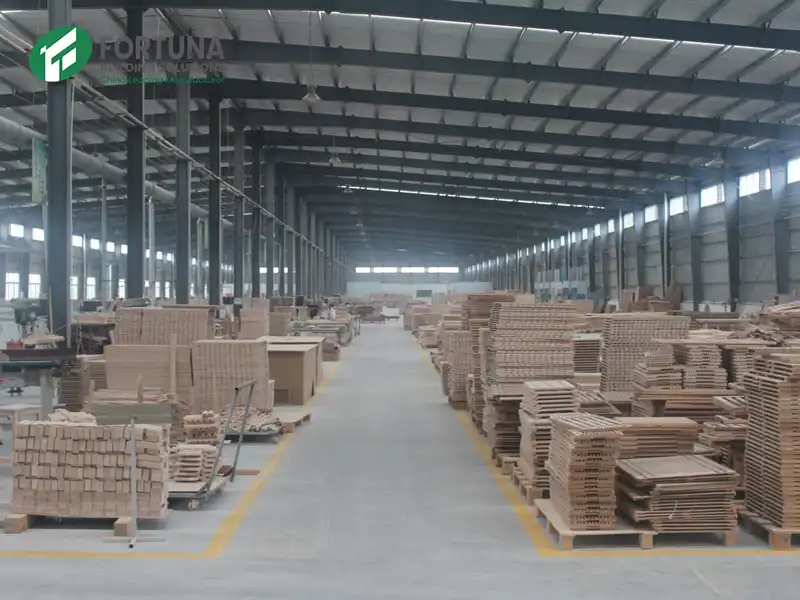
How Reliable Particle Board Manufacturers Maintain Consistent Quality
Reliable manufacturing is not achieved through a single machine or inspection process.
It is the result of controlling every stage of production—from raw material selection to final quality testing.
Experienced particle board manufacturers typically invest in:
- Stable raw material sourcing
- Automated blending and resin application
- Precision hot pressing systems
- Thickness calibration and surface sanding
- Moisture content monitoring
- Batch-by-batch quality inspection
- Standardized production procedures
These investments may not always be visible on a quotation sheet, but they directly influence how the board performs once it reaches your factory.
For wholesale buyers, this means more predictable production, fewer quality claims, and better control over manufacturing costs.
How Fortunaply Helps Buyers Reduce Manufacturing Risks
At Fortunaply, we believe that purchasing particle board wholesale should create confidence—not uncertainty.
That is why our manufacturing process focuses on delivering consistent quality, not simply meeting a target specification.
With more than 30 years of manufacturing experience, a 208,000㎡ production base, and an annual production capacity exceeding 300,000m³, we have developed production systems designed to support long-term wholesale programs as well as large commercial projects.
More importantly, these manufacturing capabilities translate into practical benefits for our customers.
Stable Quality Means More Predictable Production
Consistent board density helps furniture manufacturers achieve cleaner CNC machining, smoother edge banding, and more reliable assembly quality.
This reduces production adjustments, minimizes material waste, and improves manufacturing efficiency.
Certified Products Help You Enter More Markets
Different countries require different environmental and quality standards.
Our products comply with FSC, CE, CARB P2, and ISO9001 requirements, helping importers, distributors, and manufacturers meet international project specifications with greater confidence.
For buyers, this reduces compliance risks while expanding opportunities in regulated export markets.
Decorative Surface Solutions Reduce Processing Time
Beyond plain particle board, Fortunaply also supplies melamine-faced boards, PET laminated panels, UV-coated decorative boards, and other finished solutions.
Receiving ready-to-use decorative panels allows many furniture manufacturers to simplify production, shorten processing time, and improve overall manufacturing efficiency.
Flexible OEM Manufacturing Supports Business Growth
Every market has different product requirements.
Whether you require customized board dimensions, specific density ranges, decorative finishes, private-label branding, or OEM production, our manufacturing capabilities are designed to help distributors and furniture manufacturers develop products that better match their target markets.
Rather than adapting your business to standard inventory, we work with customers to deliver specifications that support long-term growth.
Expert Recommendation
When evaluating a particle board supplier, compare more than price.
Ask about manufacturing consistency, production capacity, certification standards, quality control procedures, export experience, and technical support.
In the long run, a reliable supplier can reduce production costs far more effectively than simply offering the lowest quotation.
Buyer Checklist Before Requesting a Quotation
Before sending an RFQ, verify that the following information is clearly defined:
✔ Board thickness
✔ Required particle board density
✔ Density tolerance (if applicable)
✔ Board dimensions
✔ Surface finish (Plain, Melamine, PET, UV, Veneer)
✔ Moisture content requirements
✔ Formaldehyde emission standard (CARB P2, E1, E0)
✔ Certification requirements (FSC, CE, ISO9001)
✔ Packaging requirements
✔ Container loading preference
✔ End application
✔ Annual purchasing volume
Providing this information at the quotation stage helps your particle board supplier recommend the most suitable specification while reducing misunderstandings, production delays, and unnecessary costs.
Key Takeaways
If you’re evaluating particle board wholesale for furniture manufacturing, interior projects, or distribution, these are the most important points to remember.
- Particle board density should always be selected according to the product application—not simply the highest specification available.
- For most furniture manufacturing, 650–700 kg/m³ provides the best balance of strength, machining performance, transportation efficiency, and overall cost.
- Consistent manufacturing quality has a greater impact on long-term performance than density alone.
- A reliable particle board manufacturer helps reduce production waste, improve machining consistency, and lower total purchasing costs.
- Clear RFQ specifications allow suppliers to recommend products that better match your production requirements and target market.
- Building a long-term partnership with an experienced particle board supplier creates greater business value than comparing quotations based only on unit price.
Final Expert Insight
Successful procurement is rarely about buying the heaviest board or negotiating the lowest price. It is about selecting the right specification and partnering with a manufacturer capable of delivering consistent quality over the long term.
Frequently Asked Questions
What is the best particle board density for furniture manufacturing?
There is no universal “best” density. For most residential and commercial furniture, 650–700 kg/m³ offers an excellent balance between strength, machining performance, screw-holding capability, and transportation cost. Heavy-duty commercial furniture may require higher-density boards, while lightweight or budget furniture can often achieve excellent results with lower-density specifications.
Does higher density always mean better quality?
No.
Higher density may improve load-bearing performance in certain applications, but it also increases board weight and transportation costs. Overall board quality depends on manufacturing consistency, internal bond strength, moisture control, and production quality—not density alone.
Why is density consistency more important than nominal density?
Nominal density indicates the target specification.
Density consistency determines whether every board performs similarly during machining, lamination, assembly, and long-term use.
For furniture manufacturers processing large production volumes, consistent density reduces machine adjustments, improves production efficiency, and helps maintain stable product quality.
What information should I provide when requesting a quotation?
A complete RFQ should include:
- Board thickness
- Required particle board density
- Board dimensions
- Surface finish
- Moisture requirements
- Formaldehyde emission standard
- End application
- Quantity
- Packaging requirements
- Required certifications
Providing complete information allows your particle board supplier to recommend the most suitable specification instead of simply offering the lowest-priced product.
Which certifications are commonly required for export markets?
Requirements vary by country and project, but many international buyers request FSC, CE, CARB P2, and ISO9001 certifications to ensure environmental compliance, manufacturing consistency, and project approval.
Can particle board manufacturers customize density?
Yes.
Many experienced manufacturers can recommend or produce different density ranges according to furniture type, machining methods, decorative surface requirements, and market regulations.
Discussing your application before production is often more valuable than requesting a fixed density specification.
How do I evaluate a reliable particle board supplier?
Beyond comparing prices, consider the supplier’s:
- Manufacturing experience
- Production consistency
- Quality control system
- Export experience
- Production capacity
- Certification standards
- OEM capabilities
- Technical support
As one of the trusted particle board supplier, Fortunaply with stable manufacturing systems is more likely to deliver consistent quality across repeat orders.
Why do professional buyers prefer long-term supplier partnerships?
Long-term cooperation reduces procurement risks.
A reliable supplier understands your product specifications, maintains consistent production quality, improves communication efficiency, and helps reduce quality-related issues over time.
This creates greater value than changing suppliers for small price differences.
Conclusion
Choosing the right particle board density is not simply a technical decision—it is a business decision.
The appropriate density influences machining efficiency, furniture durability, transportation costs, production consistency, and ultimately the profitability of your business.
However, selecting the right specification is only part of the equation.
Working with an experienced particle board manufacturer that delivers consistent quality from one shipment to the next is equally important.
Whether you are sourcing particle board wholesale, developing a new furniture collection, or expanding your supplier network, evaluating both the product specification and the manufacturer’s production capability will help reduce purchasing risks while creating greater long-term value.
At Fortunaply, we combine over 30 years of manufacturing experience, a 208,000㎡ production base, 300,000m³+ annual production capacity, and internationally recognized certifications including FSC, CE, CARB P2, and ISO9001 to support furniture manufacturers, distributors, and project suppliers worldwide.
More importantly, we focus on helping our customers achieve what matters most:
More consistent production quality
Lower manufacturing waste
Reliable supply for long-term purchasing
Decorative panel solutions that improve production efficiency
Flexible OEM manufacturing tailored to different markets
If you’re looking for a reliable particle board supplier in China that understands the practical challenges of wholesale sourcing—not just board specifications—our team is ready to help you identify the right solution for your next project.
Explore our complete range of particle board products and discuss your project requirements with our technical team to find the specification that delivers the best balance of quality, performance, and long-term value.