
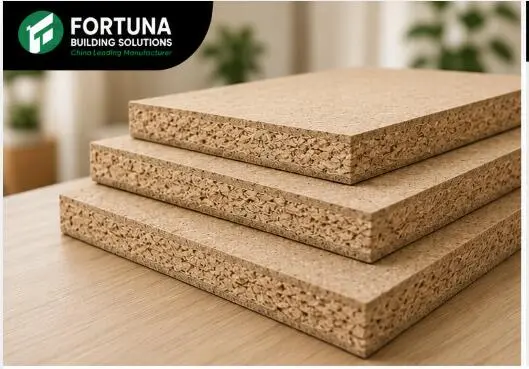
What Is Particle Board?
What exactly is particle board, and what should furniture manufacturers, importers, and wholesalers check before placing a bulk order?Particle board is an engineered wood panel made from wood particles, wood chips, sawmill residues, and resin adhesives compressed under controlled heat and pressure. It is widely used in furniture manufacturing, cabinetry, shelving systems, and interior applications because of its cost efficiency, dimensional stability, and suitability for large-scale production.
It is commonly used for ready-to-assemble furniture, kitchen cabinets, wardrobes, office furniture, shelving systems, retail displays, and commercial interiors.
For professional B2B buyers, however, the material itself is only part of the equation. Raw material preparation, particle size, moisture control, resin systems, pressing conditions, and quality inspection can all affect density consistency, machining performance, screw holding, and dimensional stability.
This guide explains the main types, manufacturing process, applications, specifications, and purchasing considerations buyers should understand when sourcing particle board from China.
What Is Particle Board Made Of?
One of the most common sourcing questions from importers and furniture manufacturers is:
What is particle board made of?
Particle board is manufactured by compressing wood particles, wood chips, sawmill residues, and resin systems under controlled heat and pressure.
The panel structure is designed to provide:
- Stable flatness
- Cost-efficient manufacturing
- Consistent density
- Good machinability
- Reliable furniture production performance
Main Raw Materials Used in Particle Board
| Material | Function |
|---|---|
| Wood Chips | Main structural layer |
| Fine Wood Particles | Improve surface smoothness |
| Resin Adhesives | Bond internal structure |
| Wax Additives | Improve moisture resistance |
| Pine Wood Fiber | Commonly used in pine particle board |
The quality of raw materials directly affects:
- Board density
- Surface smoothness
- Screw-holding capability
- Moisture resistance
- Lamination performance
- Furniture durability
High-quality particle board manufacturing requires strict control over particle size distribution, moisture content, and pressing consistency.
For furniture-grade particle board, controlling particle size distribution and moisture content before pressing is particularly important for achieving stable panel performance.
How Particle Board Is Manufactured
The manufacturing process plays a critical role in determining panel quality and long-term furniture performance.
Professional particle board manufacturers usually follow the following production steps.
1. Wood Preparation
Raw wood materials are processed into chips and particles of different sizes.
Fine particles are generally used for surface layers, while larger particles provide core structure strength.
2. Drying & Moisture Control
Wood particles are dried to controlled moisture levels before blending.
Stable moisture control is critical because excessive moisture may cause:
- Panel swelling
- Warping
- Weak internal bonding
Professional manufacturers usually maintain controlled moisture content for stable panel performance.
3. Resin Blending
Particles are blended with resin systems and additives to improve:
- Internal bonding
- Surface stability
- Moisture resistance
- Machining performance
The resin system and production controls also need to meet the emission requirements of the target market, particularly when panels are intended for indoor furniture applications.
4. Hot Pressing
The panel mat is compressed under high temperature and pressure.
This process determines:
- Density consistency
- Board strength
- Surface smoothness
- Thickness tolerance
5. Sanding & Calibration
After pressing, boards are sanded and calibrated to achieve:
- Uniform thickness
- Smooth surfaces
- Better lamination performance
- Improved furniture machining quality
6. Quality Inspection
Professional manufacturers inspect:
- Density stability
- Moisture content
- Thickness tolerance
- Internal bonding strength
- Formaldehyde emission compliance
For repeat B2B orders, consistency between production batches is just as important as the specification of the first shipment.

What Particle Board Specifications Should B2B Buyers Check?
When particle board wholesale from China, technical specifications are critical for furniture production quality. However, buyers should avoid comparing suppliers only by price per sheet. The specification needs to match the final application, machining process, decorative finish, and destination-market requirements.
Typical Particle Board Specifications
| Property | Typical / Available Specification |
|---|---|
| Density | Approximately 650–750 kg/m³ for selected Fortuna particle board products |
| Moisture Content | Typically controlled according to product and application |
| Thickness Range | 9–25mm for standard particle board products |
| Formaldehyde / Emission | E0 / E1 / CARB P2 according to product and market requirements |
| Surface Finish | Raw / Melamine / PET / UV / Acrylic |
| Common Board Size | 1220 × 2440mm; customized sizes available for selected products |
Density should not be evaluated in isolation. The appropriate density depends on the furniture design, machining process, screw-holding requirements, load conditions, panel thickness, and finished-product requirements.
For a deeper explanation of density selection and its effect on furniture applications, see our [particle board density] guide.
Common Thickness Applications
| Thickness | Common Applications |
|---|---|
| 9mm | Drawer bottoms, back panels, selected furniture components |
| 12mm | Shelving systems and furniture components |
| 15–16mm | Cabinet carcases, wardrobes, furniture panels |
| 18mm | Wardrobes, shelving, cabinets, and structural furniture components |
| 25mm | Thicker furniture panels, countertops, and selected structural applications |
These are common application references rather than universal rules. Buyers should confirm the required thickness with their furniture design, hardware system, machining process, and load requirements.
What Are the Main Types of Particle Board?
Different furniture and interior applications require different particle board constructions and surface solutions.
Plain Particle Board
Plain particle board is one of the most widely used industrial panels for furniture manufacturing.
It offers:
- Stable structure
- Smooth surfaces
- Cost efficiency
- Good lamination capability
It is commonly used as a substrate for cabinets, wardrobes, shelving, office furniture, and other manufactured furniture products.
Melamine Faced Particle Board
Melamine-faced particle board combines decorative melamine paper with particle board substrates.
Advantages include:
- Decorative finishes
- Scratch resistance
- Easy cleaning
- Faster furniture production
It is widely used for:
- Kitchen cabinets
- Wardrobes
- Office furniture
- Commercial interiors
PET, Acrylic and UV Decorative Particle Board
For higher-end furniture and interior projects, particle board can also be combined with decorative PET, acrylic, or UV surfaces. These finishes are used where appearance, scratch resistance, easy cleaning, or specific surface effects are important.
- PET: suitable for anti-scratch and anti-fingerprint decorative applications
- Acrylic: suitable for high-gloss premium furniture surfaces
- UV: suitable for super-matte and specialty decorative finishes
Hollow Core Particle Board
Hollow core particle board is designed for applications where lower panel weight is important, including interior doors, partitions, and selected thick-panel furniture systems.
Fortuna currently supplies hollow-core particle board in selected thicknesses from 33mm to 45mm, with different core structures available for project requirements.
For current product options, surface finishes, densities, thicknesses, and OEM configurations, see our [particle board supplier in China] page.

What Is Particle Board Used For?
Because of its manufacturing efficiency and decorative flexibility, particle board wholesale products are widely used across the furniture and building materials industries.
Residential Furniture
Particle board is commonly used for:
- Wardrobes
- TV cabinets
- Bedroom furniture
- Storage systems
- Bookshelves
Kitchen Cabinet Production
Kitchen cabinet manufacturers prefer particle board because it provides:
- Stable panel dimensions
- Smooth lamination surfaces
- Efficient CNC processing
- Competitive production costs
Office Furniture
Commercial office furniture manufacturers use particle board for:
- Workstations
- Filing cabinets
- Conference tables
- Office storage systems
Retail & Commercial Interiors
Particle board panels are also used in:
- Retail display systems
- Shop fittings
- Decorative wall panels
- Commercial shelving
- Hotel interiors

Particle Board vs Plywood vs MDF
One of the most important sourcing questions for furniture manufacturers is the difference between particle board vs plywood vs MDF.
Each panel material has different structural characteristics, production costs, and furniture applications.
Comparison Table
| Feature | Particle Board | MDF | Plywood |
|---|---|---|---|
| Material Structure | Wood particles & resin | Wood fiber | Wood veneer layers |
| Surface Smoothness | Good | Excellent | Moderate |
| Cost Efficiency | High | Moderate | Lower |
| Weight | Lightweight | Heavier | Moderate |
| Screw Holding | Moderate | Better | Best |
| Moisture Resistance | Moderate | Lower | Better |
| Decorative Lamination | Excellent | Excellent | Good |
| CNC Machining | Moderate | Excellent | Moderate |
| Large-scale Furniture Production | Highly suitable | Suitable | Higher cost |
Which Panel Should You Consider for Different Furniture Applications?
| Application Requirement | Commonly Considered Panel |
|---|---|
| Cost-efficient laminated furniture | Particle Board |
| Melamine furniture and cabinetry | Particle Board / MDF |
| Painted or routed furniture | MDF |
| Higher structural requirements | Plywood |
| Moisture-prone applications | Suitable moisture-resistant panels / Plywood |
There is no single panel material that is suitable for every furniture application. The right choice depends on the required surface, machining process, structural performance, moisture conditions, and overall production cost.

What Problems Should Buyers Watch for When Importing Particle Board?
Professional buyers often face quality consistency challenges when sourcing from unfamiliar suppliers.
Understanding these issues can help reduce procurement risks.
Inconsistent Density
Unstable density may lead to:
- Weak screw holding
- Poor machining performance
- Furniture instability
Reliable manufacturers maintain strict density control throughout production.
Swelling in Humid Environments
Improper moisture control may cause panel swelling after shipment or installation.
Furniture-grade particle board should maintain stable moisture content before export.
Weak Lamination Bonding
Poor surface quality may lead to:
- Decorative layer peeling
- Edge cracking
- Surface defects during furniture production
Edge Cracking During CNC Processing
Low-quality core structures may create edge damage during cutting and machining.
This directly affects furniture production efficiency.
How Should B2B Buyers Specify Particle Board?
One of the easiest ways to improve a particle board quotation is to give the supplier a complete specification instead of asking only for a price.
| RFQ Item | Information to Provide |
|---|---|
| Product Type | Plain particle board, MFC, PET, UV, acrylic, or hollow core |
| Board Size | Length × width |
| Thickness | Required thickness and tolerance |
| Density | Target density or intended application |
| Surface | Raw, melamine, PET, UV, acrylic, veneer, etc. |
| Emission Requirement | E0, E1, CARB P2, or destination-market requirement |
| Quantity | Sheets, m³, containers, or annual volume |
| Destination | Country and destination port |
| Packaging | Standard or customized export packaging |
| Application | Furniture, cabinets, shelving, doors, interior panels, etc. |
Providing the end application is particularly useful. A manufacturer can then recommend a more suitable combination of density, thickness, surface, and emission specification instead of simply quoting the lowest-cost standard board.
For example, an importer sourcing 18mm melamine particle board for wardrobes may need a different specification from a buyer purchasing thick panels for office furniture or hollow-core panels for doors.
Why Global Buyers Source Particle Board from China
China has become one of the world’s leading engineered wood manufacturing centers.
Many furniture manufacturers and distributors source from professional China particle board manufacturers because of:
- Mature industrial supply chains
- Competitive production costs
- Large-scale manufacturing capability
- Stable container-load supply
- Flexible OEM production
- Wide specification options
Reliable China particle board suppliers can support:
- Furniture factories
- Wholesalers
- Importers
- Commercial interior projects
- Building material distributors
For a closer look at supplier evaluation, see our guide on [how to choose a reliable particle board supplier in China].
Export Packaging & Container Loading Considerations
For international buyers, export packaging quality is essential for reducing transportation risks.
Professional manufacturers usually provide:
- Moisture-protected packaging
- Reinforced pallet systems
- Edge protection
- Container loading optimization
- Stable export documentation support
Proper container loading helps reduce:
- Board damage
- Surface scratches
- Moisture exposure during shipment
For bulk orders, buyers should confirm the packaging method before production, especially when panels will be shipped over long distances or through humid climates.
Why Fortuna Is Your Reliable Particle Board Manufacturer
Choosing the right supplier is essential for furniture quality, production consistency, and long-term supply stability.
As an experienced particle board supplier, Fortuna panel provides professional engineered panel solutions for global furniture manufacturers and distributors.
30+ Years of Manufacturing Excellence in Particle Board
Since 1993, we have perfected the precision-engineered orientation of wood fibers. As a trusted particle board manufacturer in China, our 3-decade heritage ensures that every panel features a structurally balanced, multi-layer gradient for superior surface smoothness and industrial-grade core strength.
Furniture-grade Quality Control
We focus on manufacturing particle board with stable:
- Density consistency
- Surface smoothness
- Moisture control
- Lamination performance
- Machining stability
Strict inspection standards help ensure reliable furniture manufacturing performance.
Certified for Global Markets
Our products comply with international standards including:
- FSC
- CARB P2
- CE
- ISO 9001
This helps support export requirements for regulated international markets.
OEM & Custom Specifications
We provide customized solutions including:
- Thickness options
- Density requirements
- Surface finishing
- Board sizes
- Furniture production specifications
This flexibility helps buyers optimize sourcing efficiency and production performance.
Advanced Surface Finishes: PET, UV & Melamine Faced Boards
We lead in decorative panel innovation. From anti-scratch PET laminated boards and super-matte Excimer UV panels to a vast library of MFC woodgrains, our integrated production provides high-end, ready-to-use solutions that significantly reduce your processing time.
Future Trends in the Particle Board Industry
The global furniture industry continues to drive innovation in engineered wood panel manufacturing.
Low-emission Furniture Panels
Demand for environmentally compliant panels such as CARB P2 and low-formaldehyde boards continues to grow globally.
Decorative Laminated Furniture Panels
Furniture brands increasingly prefer laminated particle boards for faster and more efficient manufacturing.
Sustainable Manufacturing
Global buyers increasingly prefer manufacturers with:
- FSC-certified sourcing
- Stable environmental compliance
- Sustainable manufacturing systems
FAQ About Particle Board
What is particle board made of?
Particle board is made from wood particles, wood chips, sawmill residues, and resin adhesives compressed under heat and pressure.
Is particle board good for furniture manufacturing?
Yes. Particle board is widely used for furniture manufacturing because it offers stable dimensions, smooth surfaces, and cost-efficient production capability.
What density is best for furniture-grade particle board?
Furniture-grade particle board typically ranges from 620–700 kg/m³ depending on application requirements and machining performance.
Is particle board better than MDF?
Particle board and MDF serve different manufacturing purposes. Particle board is often preferred for cost-efficient laminated furniture production, while MDF is commonly used for painted or CNC-machined furniture.
Is particle board waterproof?
Standard particle board is not waterproof, but moisture-resistant grades are available for kitchen and humid-environment applications.
FAQ About Particle Board Wholesale in Fortunaply
Can You Support Long-term Bulk Supply for Wholesale Projects?
Yes. Our manufacturing systems support stable bulk supply for furniture manufacturers, wholesalers, distributors, and commercial interior projects worldwide.
What Is the MOQ for Particle Board Orders?
Our standard Minimum Order Quantity (MOQ) for wholesale particle board is typically one full container (20ft). Bulk ordering allows us to optimize production efficiency and offer the most competitive factory-direct rates. It also significantly reduces the average shipping cost per unit for international importers and distributors.
Do You Offer OEM or Custom Particle Board Specifications?
Yes. We support customized sizes, thicknesses, densities, and furniture manufacturing requirements for OEM projects.
Are Your Particle Boards Compliant With International Standards?
Yes. Our products comply with FSC, CARB P2, CE, and ISO 9001 standards for international export markets.
Conclusion
As one of the most important engineered wood materials in modern furniture manufacturing, particle board continues to play a critical role in cabinetry, office furniture, shelving systems, and commercial interior projects.
For wholesalers, distributors, and furniture manufacturers sourcing from reliable China particle board manufacturers, understanding panel structure, density consistency, production quality, certifications, and supplier capability is essential for long-term procurement success.
Looking for a professional China particle board factory for furniture manufacturing or wholesale projects? Fortunaply provides stable bulk supply, OEM customization, export-certified engineered panel solutions, and reliable long-term cooperation for global buyers.