
Common MDF (Medium Density Fiberboard) thicknesses include 3mm, 6mm, 9mm, 12mm, 15mm, 18mm, and 25mm. Among these, 15–18mm MDF is widely used for cabinet doors, cabinet panels, and wardrobes, while thinner boards are commonly used for furniture backs, drawer bottoms, and decorative components.
For furniture manufacturers, choosing the right MDF thickness affects more than material cost. It also influences door weight, hardware installation, CNC machining, panel assembly, and long-term performance.
For example, an 18mm MDF board used for a painted cabinet door has different performance requirements from the same thickness used for a long bookshelf. Cabinet doors require attention to surface quality, routing, and hinge installation, while shelves must be evaluated for span, load, and long-term deflection.
This guide explains how to select MDF thickness for different furniture components, how thickness affects machining and production costs, and which specifications to confirm when sourcing MDF in bulk.
What Are the Common MDF Board Thicknesses?
MDF boards used in furniture manufacturing commonly range from 3mm to 25mm. Thicknesses such as 6mm, 12mm, 15mm, and 18mm are frequently selected for different furniture components.
| MDF Thickness | Common Applications | Key Considerations |
|---|---|---|
| 3mm | Furniture backs, lightweight decorative panels | Suitable for thin components with continuous support or secure fixing |
| 6mm | Drawer bottoms, cabinet backs, decorative panels | Check groove depth, panel span, and fixing methods |
| 9mm | Furniture liners, decorative components, selected backing panels | Useful where moderate thickness and lower weight are preferred |
| 12mm | Decorative panels, selected cabinet components | Check joint design and remaining thickness after machining |
| 15mm | Cabinet panels, wardrobe sides, furniture components | Balances panel weight, machining requirements, and material cost |
| 18mm | Cabinet doors, cabinet panels, wardrobe panels, selected shelves | Common furniture thickness; hardware and support design remain important |
| 25mm | Thick furniture components, display counter substrates, decorative structures | Consider increased weight, machining cost, and installation requirements |
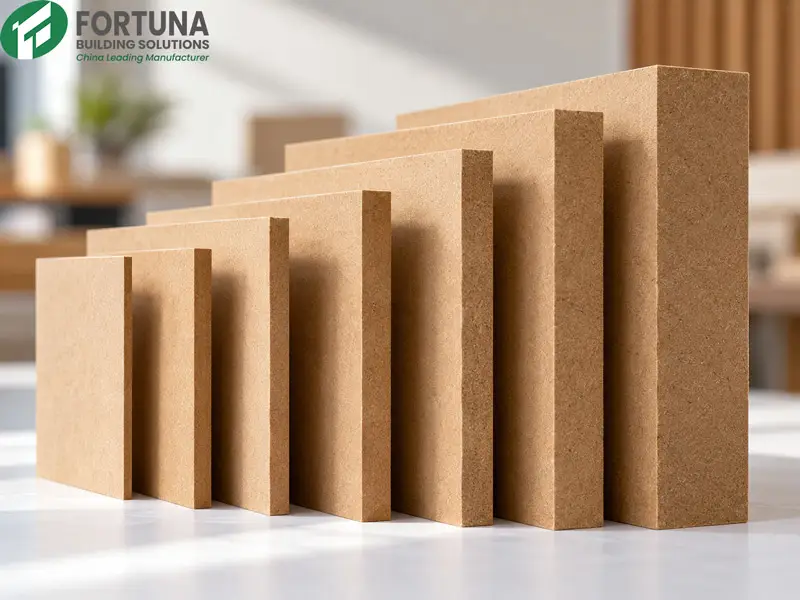
A practical way to choose MDF thickness is to divide furniture components into three groups: backing and decorative panels, cabinet doors and structural furniture panels, and shelves that carry sustained loads.
Each group has different requirements, so using one thickness throughout an entire furniture product is not always the most efficient approach.
What MDF Thickness Is Best for Furniture and Cabinets?
15mm and 18mm MDF are common choices for furniture and cabinetry, but the appropriate thickness depends on the component’s dimensions, joint design, hardware, and finishing requirements.
Why Is 18mm MDF Commonly Used for Cabinet Doors?
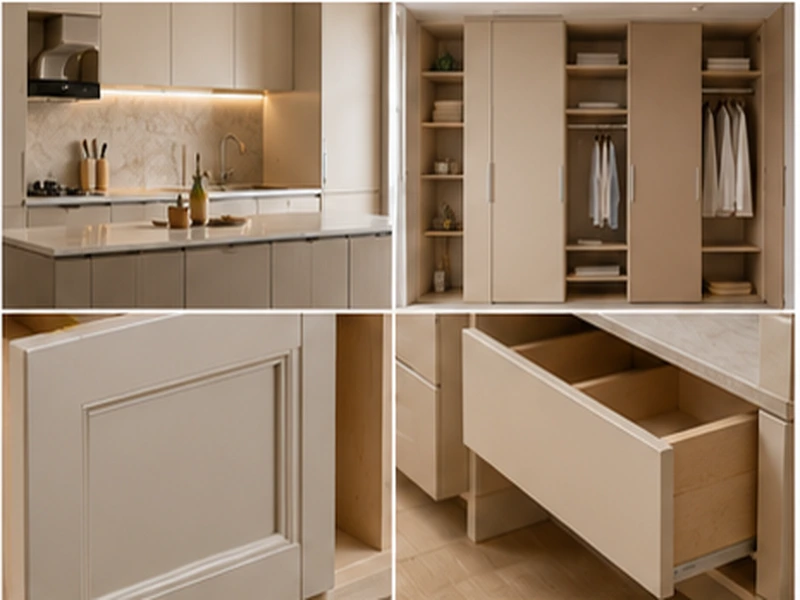
18mm MDF is widely used for painted cabinet doors, routed door panels, and selected wardrobe doors because it provides sufficient material for many common edge profiles, grooves, and hardware installations.
However, thickness alone does not determine whether a board is suitable for a particular door design.
Door dimensions and weight. Larger doors place greater demands on hinges and fixing points. Two doors made from the same thickness of MDF may require different hardware arrangements depending on their size and weight.
CNC routing depth. For deeply routed profiles or decorative grooves, manufacturers must check how much material remains after machining. Excessively thin sections may compromise the finished component.
Surface and edge quality. Painted cabinet doors require consistent sanding and clean machined edges. Variations in board density can increase primer consumption, sanding work, and finishing adjustments.
Hardware installation. Hinge cup depth, screw length, hole positions, and edge distances must be compatible with the panel thickness and material properties.
For high-volume cabinet door production, testing the intended MDF grade through routing, painting, and hardware installation before finalizing the specification can help reduce rework and production inconsistencies.
Should You Use 15mm or 18mm MDF for Cabinet Panels and Wardrobes?
Both 15mm and 18mm MDF can be used for selected cabinet and wardrobe components. The decision depends mainly on panel dimensions, stiffness requirements, joining methods, weight, and material consumption.
For smaller cabinet components with suitable support and joint design, 15mm MDF may help reduce material usage. For larger panels or components requiring additional stiffness or machining depth, 18mm may be more appropriate.
Furniture manufacturers should also consider the connection system. Cam-lock fittings, dowels, and other hardware may have specific requirements for board thickness, drilling accuracy, and edge distances.
When using melamine-faced MDF, the substrate thickness, decorative surface, edge banding, and machining parameters must work together.
For wardrobe doors, panel height, weight, hinge configuration, and long-term flatness are also important considerations.
For more information on material selection and processing, see MDF for furniture manufacturing.
What MDF Thickness Should You Use for Shelves?
MDF shelf thickness should be selected according to span, expected load, support arrangement, and panel stiffness. Although 18mm MDF is commonly used in furniture, it is not suitable for every shelving design.
Three factors deserve particular attention.
How Does Shelf Span Affect MDF Thickness?
Span is one of the main factors influencing shelf deflection.
A shelf supported only at both ends may gradually sag under sustained loads, particularly when the distance between supports is large.
For longer shelves, manufacturers may need to increase panel thickness, reduce the unsupported span, or add a front-edge stiffener or intermediate support.
How Much Weight Will the Shelf Carry?
A shelf displaying lightweight decorative items has different requirements from one designed to store books, files, or heavy equipment.
The expected load, load distribution, and duration of loading should be established before selecting the board.
A shelf’s load capacity cannot be determined from its nominal thickness alone. Bending properties, span, and support conditions must also be considered.
Can Shelf Design Reduce Deflection?
Yes. Adding intermediate dividers, continuous supports, or suitable front-edge reinforcement can improve shelf performance.
For furniture designed to carry sustained loads, improving the support structure may be more cost-effective than simply increasing MDF thickness.
How Does MDF Thickness Affect Machining and Production Costs?
Thicker MDF generally provides greater bending stiffness under comparable conditions, but it also increases panel weight and material consumption. Actual machining performance depends on density, internal bond strength, surface quality, and processing conditions.
For furniture manufacturers, three areas are especially important.
CNC Machining and Surface Finishing
For painted cabinet doors, routed panels, and decorative profiles, board thickness determines how much material is available for machining.
However, the quality of the finished surface also depends on fiber structure and density consistency.
For example, two 18mm MDF boards from different grades may perform differently during deep routing, edge sanding, and painting.
Buyers should therefore evaluate surface quality, internal bond strength, and edge machining performance alongside thickness.
Thickness Tolerance and Furniture Assembly
Thickness tolerance directly affects consistency in furniture production.
If actual panel thickness varies significantly within a batch, manufacturers may encounter inconsistent groove fits, hardware adjustments, edge-banding issues, and variations in assembly gaps.
For factories using automated CNC equipment and standardized furniture fittings, consistent panel thickness can help reduce machine adjustments, rework, and material waste.
Thickness and Total Purchasing Cost
MDF purchasing costs should not be compared solely on a per-sheet basis.
For example, when panel dimensions and density are the same, an 18mm MDF board contains approximately 20% more material by volume than a 15mm board.
If the furniture design allows the use of 15mm MDF, material consumption may be reduced. However, the overall cost also depends on joint design, machining waste, and finished-product performance.
Thicker panels also increase shipment weight and may affect container loading quantities.
The most economical choice is therefore the thickness that meets the required design and manufacturing performance without unnecessary material use.
How to Choose MDF Thickness and Specifications for Bulk Furniture Production
For bulk furniture manufacturing, MDF specifications should be determined by product design and processing requirements before confirming thickness, density, panel size, tolerances, surface quality, and emission requirements.
The following factors are particularly important when evaluating MDF for production.
| Specification | What to Confirm | Why It Matters |
|---|---|---|
| Thickness and tolerance | Nominal thickness and allowable variation | CNC machining, assembly, and hardware installation |
| Density | Required density grade and consistency | Machining behavior, weight, and mechanical properties |
| Panel dimensions | Length, width, and dimensional tolerance | Cutting efficiency and material waste |
| Surface quality | Sanding consistency, flatness, visible defects | Painting, laminating, and decorative finishing |
| Internal bond strength | Required performance and test results | Panel integrity and machining performance |
| Moisture resistance | Intended environment and appropriate grade | Kitchen cabinets and other humid indoor applications |
| Formaldehyde emissions | Applicable market requirements and supporting documents | Product compliance and import acceptance |
| Packaging and quantity | Pallet protection, order volume, loading requirements | Transport protection and purchasing costs |

Fortuna MDF Manufacturing Capabilities and Product Specifications
Established in 2008, Shandong Fortuna’s MDF factory covers approximately 280,000 square meters and operates an automated production system incorporating German Dieffenbacher continuous press technology.
The continuous press system enables controlled pressing conditions, including temperature and pressure, supporting consistent panel formation and density distribution. For furniture manufacturers, these production characteristics are important for cutting, drilling, routing, and surface finishing.
With a daily MDF production capacity of 2,000 m³ and an annual output of approximately 600,000 m³, Fortuna supports large-volume supply for importers, distributors, and furniture manufacturers.
Fortuna uses fresh poplar wood rather than recycled wood materials in its MDF production. Wood preparation, fiber refining, continuous pressing, and sanding are integrated into the manufacturing process to produce MDF panels for furniture and interior applications.
The factory also operates an in-house quality control laboratory. Production monitoring, panel testing, and finished-product inspection help maintain product quality and consistency across production batches.
Fortuna MDF Product Specifications
| Specification | Available Options |
|---|---|
| Thickness | 2–40mm |
| Density | 630, 650, 680, and 700+ kg/m³ grades |
| Panel sizes | 1220 × 2440mm, 1830 × 2440mm, 2100 × 2800mm, 1830 × 3660mm |
| Product types | Standard MDF, moisture-resistant MDF, fire-retardant MDF, and related high-density fiberboard products |
| Surface options | Raw MDF and decorative-faced panel options |
| Formaldehyde emission classifications and requirements | E0, E1, E2, and CARB P2 options |
Buyers can explore Fortuna’s MDF board specifications to review available product options for furniture manufacturing and bulk purchasing.
What Should Buyers Know About E0, E1, E2, and CARB P2 MDF?
E0, E1, E2, and CARB P2 refer to formaldehyde emission classifications or requirements associated with different standards and regulatory systems. Buyers should select the appropriate specification according to their destination market, customer requirements, and applicable testing methods.
E0, E1, and E2 are used in different standards systems, and their exact emission limits and test methods depend on the referenced standard. These classifications should not be treated as directly interchangeable without checking the relevant requirements.
CARB P2 refers to California’s formaldehyde emission requirements for composite wood products. For MDF supplied to the United States, buyers should also confirm the applicable federal TSCA Title VI requirements and supporting compliance documentation.
For export-oriented furniture manufacturers, emission requirements should be confirmed during raw material sourcing rather than at the finished-product shipment stage.
What Information Should Buyers Provide When Requesting an MDF Quotation?
To receive an accurate product recommendation and quotation, buyers should provide:
Application: Cabinet doors, cabinet panels, wardrobes, shelves, or other furniture components
Panel specifications: Thickness, dimensions, density, and tolerance requirements
Surface requirements: Raw MDF, paint-grade substrate, or specified decorative finish
Performance requirements: Moisture resistance, machining properties, and emission requirements
Purchasing details: Estimated quantity, destination port, and delivery requirements
Furniture drawings, technical specification sheets, or reference samples can also help confirm the appropriate panel configuration.
Sourcing MDF Boards for Furniture Manufacturing?
Fortuna works with furniture manufacturers, importers, and distributors to match MDF specifications with production and purchasing requirements.
Share your required thickness, dimensions, density, surface finish, order quantity, and destination to discuss suitable products and bulk pricing.
Frequently Asked Questions About MDF Thickness
Does Thicker MDF Always Have Better Screw-Holding Strength?
Not necessarily. Board thickness affects the available space for fasteners, but screw-holding performance also depends on density, internal structure, screw type, hole position, and edge distance.
For cabinet hinges and furniture connectors, practical installation testing is recommended.
Can Different MDF Thicknesses Be Used in the Same Furniture Product?
Yes. Furniture manufacturers can use different thicknesses for different components, such as thinner backing panels and thicker cabinet doors or structural furniture panels.
This approach can help balance product performance, weight, and material cost.
Does Moisture-Resistant MDF Need to Be Thicker Than Standard MDF?
Not necessarily. Moisture resistance and thickness are separate selection criteria.
For kitchens and other humid indoor environments, buyers should choose an appropriate moisture-resistant MDF grade, while determining thickness according to panel dimensions, structural requirements, and machining needs.
Conclusion: Choosing the Right MDF Thickness for Furniture Manufacturing
There is no single MDF thickness that suits every furniture application.
Cabinet doors require attention to routing depth, hardware compatibility, and surface quality. Cabinet panels must meet joint design and assembly requirements, while shelves need to be evaluated for span, loading, and support conditions.
For bulk furniture production, thickness tolerance, density, machining performance, emission requirements, and batch consistency are equally important.
Fortuna offers a range of MDF thicknesses, panel dimensions, and density grades for furniture manufacturers, importers, and distributors. Review our MDF board specifications or contact our team to discuss your requirements and request a bulk quotation.